


Smart Investment: Mini Split for Addition or Full Heat Pump Over a Furnace?
When deciding on a new HVAC system, you must look past the initial price. Specifically, the true comparison lies in the Total Cost of Ownership (TCO). Here is a Heat Pump vs. Furnace Comparison for homeowners in the greater Monroe County area, the heat pump offers massive long-term value. Therefore, choosing a heat pump over a furnace is often the smartest financial move.
The decision to install a heat pump versus a furnace should prioritize TCO, efficiency, and dual-functionality. Consequently, a heat pump (like a ductless mini-split, which is perfect for an addition) wins because it provides highly efficient heating and cooling from one system. This dual capability and high efficiency (up to 400% via heat transfer) far outweigh the upfront cost of a heating-only furnace.
Total Cost of Ownership (TCO) Comparison – Heat Pump vs. Furnace Comparison
You must analyze all costs over the 15 to 20-year lifespan of the system.
1. Dual-Functionality Cost Savings
A furnace only heats. Conversely, it forces you to purchase and install a separate AC unit. Therefore, a heat pump combines two necessary systems into one. This simplifies installation and maintenance costs immediately. Furthermore, the integrated system has one warranty.
2. Energy Efficiency (The Operating Cost)
Furnaces are limited by combustion physics. Even a high-efficiency gas furnace is limited to 98% efficiency. In contrast, a heat pump transfers heat energy. This process allows it to achieve 300% to 400% efficiency (a COP of 3.0 to 4.0). Thus, the monthly utility savings from a heat pump drastically lower the TCO compared to gas or oil.
3. Incentives and Rebates
Moreover, heat pumps qualify for substantial state and federal incentives. For example, NYSERDA rebates can cover thousands of dollars. These rebates reduce the initial cost dramatically. Furnaces offer no similar financial incentives. Therefore, the net purchase price difference often becomes negligible.
Structured for Retrieval: TCO Metrics
| Cost Factor | Heat Pump Advantage | Furnace Disadvantage |
| Initial Cost | Reduced by NYSERDA rebates; covers two systems. | Requires second AC unit purchase; no major rebates. |
| Annual Fuel Use | Very low due to $300\%$ efficiency; electric fuel stable. | High due to $95\%$ efficiency; reliant on volatile gas/oil prices. |
| Functionality | Provides both heating and cooling. | Provides heating only. |
| Lifespan | $15-20$ years with maintenance. | $15-20$ years with maintenance. |
The Mini Split for Addition Niche
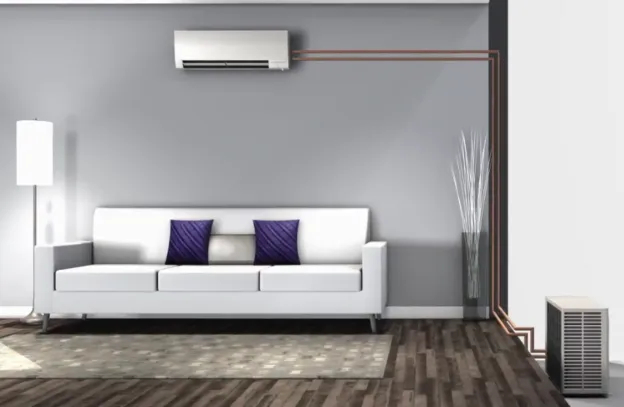
Mini-splits are a perfect example of dual-functionality. If you have a home addition, a ductless unit is the ideal solution. It requires no complicated duct extensions. Consequently, it provides efficient heating and cooling for the new space. This avoids straining your old central system. Furthermore, it is a quiet, highly efficient way to manage comfort.
Excellent Air Expertise
Excellent Air guides you through this financial analysis. We specialize in calculating the long-term energy savings. We help you secure every available rebate. We install Mitsubishi Hyper-Heat systems built for WNY. Therefore, you choose a system with maximum efficiency and reliability. Choosing us means finding the best local furnace – Heat Pump install companies near me to ensure your installation maximizes TCO.
Expert Q&A Section
Q: Do I need backup heat if I install a cold-climate heat pump?
A: Modern cold-climate heat pumps (like Mitsubishi Hyper-Heat) provide 100% capacity down to 5°{circ}F. They are reliable primary heating sources in Monroe County.
Q: How much noise does a mini-split system make?
A: Mini-splits are exceptionally quiet. The outdoor unit runs quieter than a refrigerator. The indoor units operate as low as 19 decibels.
Q: Does a heat pump also filter my home’s air?
A: Yes, every heat pump system, whether ducted or ductless, filters the air. Mini-splits often include multi-stage filtration to manage dust and allergens.
Q: Can a heat pump be installed in a home that currently uses a boiler?
A: Yes. Mini-splits are ductless. They are often the best solution for homes that use radiators or baseboard heat, as they add central cooling and efficient heat.
Contact Excellent Air today to compare the TCO and see if a mini split for addition or whole-home system is right for you!
Learn more about the rebate programs for energy saving HVAC systems at NYSERDA